The Glory of Rome is free, open source, and has no tracking.
History#
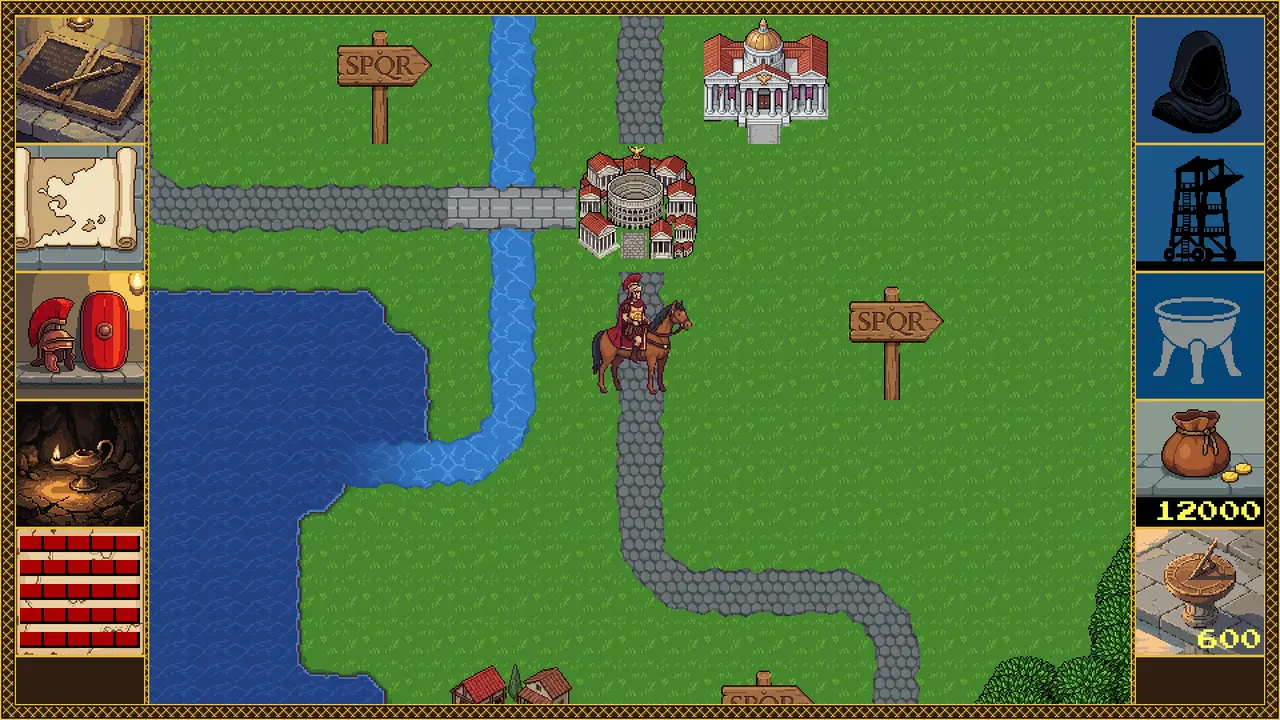
The Glory of Rome is a new game made for openbounty, the reimplementation of King’s Bounty (New World Computing, 1990). It keeps King’s Bounty’s rules and numbers and moves the whole game to the Roman Empire: legions for armies, provinces for continents, Rome’s enemies for its villains, and the eagle standard for the Sceptre of Order. The art, maps, story and introduction are new.
The story#
A legion of Rome marched to the frontier expecting victory and glory worthy of Emperor Traianus. In the dark forests beyond the Rhine it met a determined enemy. The legion fell until only the bearer of the Aquila, the sacred eagle standard, was left. Then he fell too, and the eagle was carried off to parts unknown.
The news reaches the Forum. Worse follows: the greatest enemies the Empire has ever faced have risen together and seized castles in every province. They conspired to take the eagle, and they split the map to its hiding place among themselves.
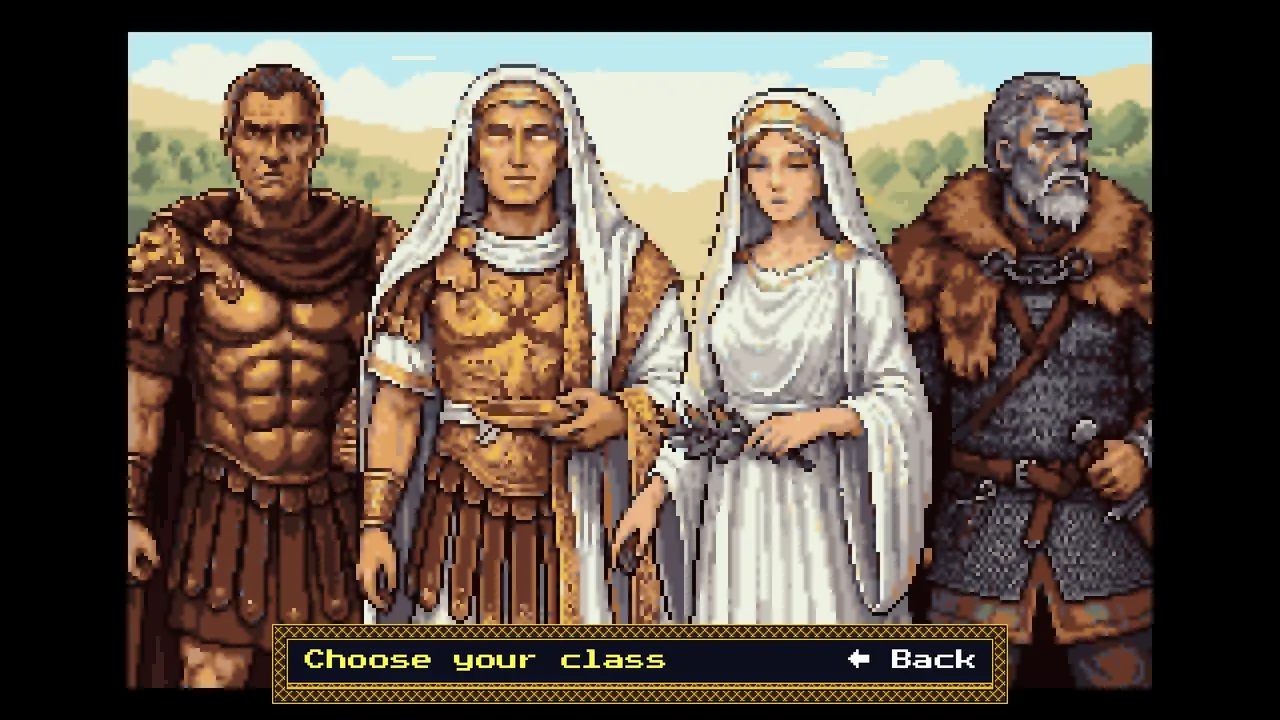
Traianus summons four champions to the Palatium:
- The Legatus, a commander of the legions, born to lead and destined for the consulship.
- The Praetorianus, of the Emperor’s own guard, as able in the sacred rites as in command, and well provided with gold.
- The Sibylla, a priestess of Apollo, who already knows the mystic rites and wields the strongest magic in the Empire.
- The Dux, a war leader of the frontier, whose warriors follow anywhere, and who draws a generous commission.
You are one of them. Take a contract at any town, lay siege to the enemy’s castle, and bring them to the Emperor in chains. Every enemy captured, and every one of eight sacred artifacts recovered, returns a piece of the map. When the map is whole, search the ground it shows and raise the eagle. The treasury pays you each week, by your rank and your service, and from it you raise and pay your army. Soldiers who go unpaid leave. Every day the eagle is lost, the provinces slip further into chaos.
The war runs across four provinces:
- Italia: the peninsula, the Po valley under the Alps, and Roma itself, the Emperor’s seat.
- Galliae: Gaul, with Britannia across the northern sea and Hispania beyond the Pyrenees.
- Africa: the coast road from the Maghreb to the Nile, with the Sahara at its back.
- Oriens: the Anatolian highlands, the Levant, and the Parthian frontier.
The seventeen wanted are Catiline, Spartacus, Brennus, Pyrrhus, Alaric, Attila, Boudica, Civilis, Vercingetorix, Arminius, Tacfarinas, Jugurtha, Gildo, Hannibal, Mithridates, Zenobia and Shapur, each with a bounty and a list of crimes. Against them you raise the legion (Tirones, Velites, Hastati, Equites, Praetoriani), auxiliaries such as Balearic slingers, Numidian horse and Sarmatian riders, and the creatures of Roman myth, from household Lares to Cyclopes, Furies and Dracones.
Technical details#
Source code: github.com/dannyheskett/openbounty, MIT license. The Glory of Rome is a game pack for the openbounty engine, in assets/glory-of-rome/. The openbounty page covers the engine, the pack format and the automated players.
Play in your browser#
Play it here. Nothing to install. Saves stay in your browser between visits.
Play on your computer#
Windows, macOS, and Linux versions are on the latest release, in the files that start with gloryofrome. There is no installer. Unzip and run it. The game is included, so there is nothing else to supply. On macOS, right-click it and choose Open the first time.
Play on your phone#
The Glory of Rome is in testing on iPhone, iPad and Android. Sign up to test it.
Controls#
Every action is also a menu row or a tap. On a keyboard, the arrow keys or the numpad move you, G travels to any place you have seen on the map, and Esc opens the game menu. The view keys open the panels: A army, V character, I contract, P the map to the Aquila, M the world map.
The full keybinding table is in the README.
The game in numbers#
| Provinces | 4 |
| Enemies to capture | 17 |
| Sacred artifacts | 8 |
| Map pieces | 25, one per enemy and artifact |
| Classes | 4, each with four ranks |
| Troop types | 27 |
| Spells | 14 |
| Towns | 27 |
| Castles | 26 |
| Days to win | Easy 900, Normal 600, Hard 400, Impossible 200 |
| Week | 5 days |
The rules are King’s Bounty’s, renamed, with the same numbers. GLORY-OF-ROME.md maps one onto the other.
Downloads#
The Glory of Rome downloads are the gloryofrome-* files: the engine binary with the pack beside it. The openbounty-* files are the engine alone, for King’s Bounty.
- Windows: a single
.exe, statically linked. No DLLs. - macOS: a universal binary (Apple Silicon + Intel), ad-hoc signed. On first run, right-click → Open to get past Gatekeeper.
- Linux: built on Ubuntu 22.04 against glibc 2.35.
- Android: a sideload
.apk, and the.aabfor Google Play. - iOS: an
.ipa, also delivered through TestFlight.
The pack#
Everything that makes the game Rome lives in the pack: the rules data, the maps, the art, the sound and the text.
The pack runs the engine in its modern mode. King’s Bounty draws into the original 320×200 VGA buffer with an 8×8 bitmap font. The Glory of Rome declares an 800×504 buffer, draws its text in a TrueType face, and uses 96×96 tiles in place of 48×34. The screen is scaled by a whole number, three at most, and any space left over goes to the map. The four province maps are 64 tiles wide and 128, 64, 28 and 44 tall, built from sources in art/maps/ by tools/mapbuild.py.
The intro’s sound effects are CC0 recordings from Freesound, credited in CREDITS.txt. The text face is Press Start 2P, under the SIL Open Font License.
Phones#
The Android and iOS builds carry The Glory of Rome only, with the pack bundled inside the app and no pack picker. Both are landscape-only and keep the game clear of the camera cutout, the home indicator and the gesture bar. Android is a NativeActivity built by the makefile with no Gradle. iOS draws with its own Metal backend in place of raylib, and every iOS build happens on GitHub’s macOS runners.